
 Vesiculab provides innovative and high-performance solutions for nanobiology research, covering extracellular vesicles (EVs), gene therapy, and nanomedicine. Headquartered in Nottingham, UK, Vesiculab supports scientists worldwide by supplying reagents and consumables that streamline sample preparation and downstream analysis workflows. Its product development is aimed at accelerating translational research at the nanoscale, with a focus on: extracellular vesicles (exosomes, microvesicles), nanomedicines (lipid nanoparticles, liposomes), viral vectors (lentivirus, adeno-associated virus), and other biological or synthetic nanoparticles (viruses, vaccines, virus-like particles).
■ Product Portfolio
Vicbio Biotechnology Co., Ltd. provides the full range of Vesiculab products.
⇨ Inquire or Order immediately ⇦
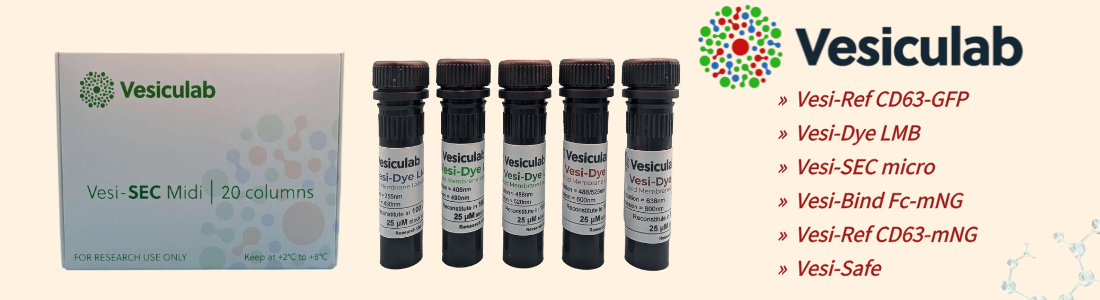
•Vesi-Ref CD63-GFP: A reference material designed to introduce certainty and repeatability into functional nanoparticle analysis. By benchmarking the limits of detection for instruments measuring size, concentration, and fluorescent biomarker labeling, it helps ensure accurate characterization of unknown samples. Compatible platforms include NTA, DLS, nFCM, TEM, SP-IRIS, TRPS, and MRPS.
•Vesi-Dye LMB:A water-soluble, lipid-membrane–targeting fluorescent dye that delivers bright, stable signals without dye transfer. As a conjugated oligoelectrolyte (COE), it selectively inserts into lipid bilayers such as EVs/exosomes, liposomes, enveloped viruses, and mitochondria. It disperses readily in aqueous media and avoids forming micelles or aggregates that can confound nanoparticle measurements. Its fluorogenic behavior also reduces background, enabling weak-signal detection on most modern flow cytometers. Available variants: LMB-430 / -490 / -520 / -600 / -800.
•Vesi-SEC micro: Size-exclusion chromatography (SEC) spin columns for fast, efficient removal of excess reagents prior to EV and bionanoparticle analysis. Immediate post-incubation cleanup (e.g., unbound dyes/antibodies) improves sensitivity with minimal sample loss. Built on proprietary Core-Sep gel (40–70 µm; 30–40 nm pore range), optimized for centrifugation-based workflows and ideal for removing small molecules and biological contaminants from samples such as EVs/exosomes, OMVs, lentivirus, adenovirus, liposomes, and lipid nanoparticles. Suitable for prep prior to FCM, f-NTA, F-MRPS, nFCM, confocal microscopy, SMLM, and SP-IRIS.
•Vesi-Bind Fc-mNG: Engineered extracellular vesicles enabling surface decoration with antibodies via Fc-domain binding (human IgG1, mouse IgG2, or rabbit IgG). Developed by the Samir El Andaloussi group (Karolinska Institute), these EVs are isolated from engineered cells and feature luminal mNeonGreen (mNG) expression (in the presence of CD63) together with Fc-binding functionality—supporting standardized, modular EV functionalization.
•Vesi-Ref CD63-mNG: A next-generation exosome reference material derived from HEK293 engineered cells. EVs express mNeonGreen in association with the tetraspanin CD63. mNeonGreen (Ex 506 nm / Em 517 nm) is compatible with common GFP/FITC filter sets, offers higher brightness than GFP, and improved photostability—well suited for confocal and super-resolution imaging, especially for low-expression fusion proteins.
•Vesi-Safe:A stabilization buffer formulated to preserve EV integrity and bioactivity during storage and experimental handling. EVs are highly sensitive to temperature fluctuations, pH changes, and freeze–thaw cycles; Vesi-Safe helps maintain long-term structural stability and functional performance.


