
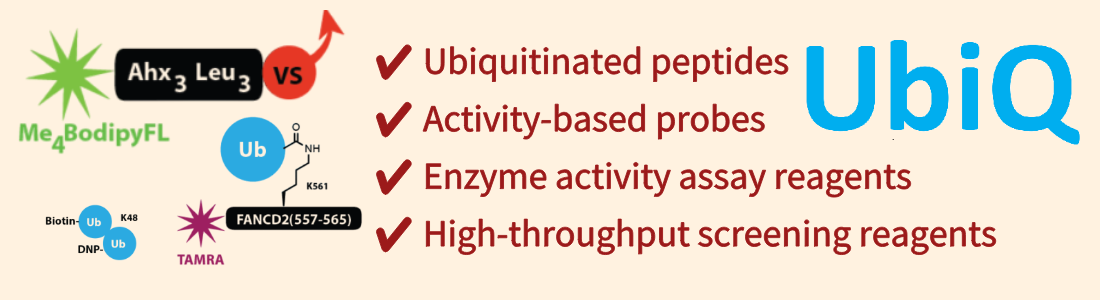
 Founded in 2010, UbiQbio is headquartered at the Amsterdam Science Park in the Netherlands, where its laboratories focus on the development and production of research reagents based on ubiquitin and ubiquitin-like proteins (Ubls).The company operates a proprietary technology platform built around three core innovations: UbiQ-Block™, UbiQ-Click™, and UbiQ-Syn™.Using these advanced chemical synthesis technologies, UbiQbio is able to construct virtually any ubiquitin conjugate, ubiquitin mutant, or combination thereof, providing powerful tools for ubiquitin biology and proteomics research.UbiQbio’s product portfolio includes:Ubiquitinated peptides, Activity-based probes, Enzyme activity assay reagents, High-throughput screening reagents, Specialized ubiquitin research tools. These products are widely used in ubiquitin signaling studies, enzyme activity profiling, and drug discovery research.
■ UbiQbio Technology Platform
Vicbio Biotechnology Co., Ltd. provides the full range of Ubiqbio products.
⇨ Inquire or Order immediately ⇦
●UbiQ-Block™
UbiQ-Block™ technology is a highly efficient chemical ligation strategy that enables the site-selective and native construction of peptides modified with ubiquitin (Ub) and/or ubiquitin-like proteins (Ubls).The key building blocks of this technology are proprietary γ- and δ-thiolysine modules, which can be readily synthesized from commercially available reagents and incorporated into peptides using conventional automated Fmoc solid-phase peptide synthesis (SPPS).
Applications
☉High-throughput screening (HTS) assays for deubiquitinase (DUB) inhibitor discovery
☉DUB activity analysis
☉Antibody development
☉Fundamental research in ubiquitin signaling
●UbiQ-Click™
UbiQ-Click™ technology enables the synthesis of well-defined, proteolytically stable ubiquitin-modified (poly)peptides.In this approach, the native isopeptide bond is replaced with a protease-resistant amide isostere, resulting in conjugates that retain structural characteristics while offering improved stability.
Applications
☉Inert crystallization tools for structural biology
☉Immunization with modified peptide antigens to generate antibodies selective for modified proteins/peptides
☉Affinity supports for mass spectrometry–based proteomics
☉DUB binding and affinity studies
☉Basic ubiquitin research
●UbiQ-Click™
UbiQ-Syn™ is a newly developed high-efficiency linear solid-phase peptide synthesis technology designed for the total synthesis of the 76–amino acid ubiquitin peptide sequence.This platform enables the production of ubiquitin mutants that cannot be generated using conventional biological expression methods. In addition, affinity tags and fluorescent dyes can be incorporated during synthesis.
Applications
☉Investigating ubiquitin–protein interactions
☉Studying E1/E2/E3 enzymatic conjugation mechanisms
☉Serving as intermediates for specialized products such as radiolabeled ubiquitin
☉Fundamental ubiquitin biology research
■ Product List
| Product name | Cat. # | Size |
| Ub-AMC | UbiQ-001 | 100 µg |
| Ub-Rh110Gly | UbiQ-002 | 100 µg |
| TAMRA-Ub | UbiQ-003 | 100 µg |
| Ub-VME | UbiQ-005 | 50 µg |
| Ub-FP | UbiQ-012 | 50 µg |
| K6 linked di-ubiquitin | UbiQ-013 | 50 µg |
| K11 linked di-ubiquitin | UbiQ-014 | 50 µg |
| K27 linked di-ubiquitin | UbiQ-015 | 50 µg |
| K29 linked di-ubiquitin | UbiQ-016 | 50 µg |
| K33 linked di-ubiquitin | UbiQ-017 | 50 µg |
| Me4BodipyFL-Ahx3Leu3VS | fluorescent proteasome probe | UbiQ-018 | 50 µg |
| NEDD8-FP | UbiQ-019 | 50 µg |
| SUMO1-FP | UbiQ-020 | 50 µg |
| SUMO2-FP | UbiQ-021 | 50 µg |
| 5-TAMRA-Lys-Gly-OH | UbiQ-023 | 25 µg |
| Ub-FANCD2-FP | UbiQ-029 | 25 µg |
| K13 Ub-PTEN(5-21)-FP | UbiQ-030 | 25 µg |
| K48 linked di-ubiquitin | UbiQ-033 | 50 µg |
| K63 linked di-ubiquitin | UbiQ-034 | 50 µg |
| HA-Ahx-Ahx-Ub-VME | UbiQ-035 | 50 µg |
| Ub-aminoluciferin | UbiQ-036 | 100 µg |
| K119 Ub-H2AX(115-143)-FP | UbiQ-038 | 25 µg |
| Ub-yH2AX-Ser140(PO4)-FP | UbiQ-039 | 25 µg |
| K382 Ub-p53(368-389)-FP | UbiQ-041 | 25 µg |
| K382 Ub-p53(357-389)-FP | UbiQ-042 | 25 µg |
| Ub-Ub(1-14)-FP K6 linked | UbiQ-043 | 25 µg |
| Ub-Ub(4-17)-FP K11 linked | UbiQ-044 | 25 µg |
| Ub-Ub(20-33)-FP K27 linked | UbiQ-045 | 25 µg |
| Ub-Ub(22-35)-FP K29 linked | UbiQ-046 | 25 µg |
| Ub-Ub(26-39)-FP K33 linked | UbiQ-047 | 25 µg |
| Ub-Ub(41-54)-FP K48 linked | UbiQ-048 | 25 µg |
| Ub-Ub(56-69)-FP K63 linked | UbiQ-049 | 25 µg |
| TAMRA-Ub-VME | UbiQ-050 | 50 µg |
| Biotin-Ahx-Ub-VME | UbiQ-054 | 50 µg |
| (Biotin-Ahx-Ub)-(DNP-Ahx-Ub) K48 | UbiQ-056 | 50 µg |
| Ub-PA | UbiQ-057 | 50 µg |
| TAMRA-Ub-PA | UbiQ-058 | 50 µg |
| H2A(113-127) K120Ub | UbiQ-061 | 50 µg |
| linear di-ubiquitin | UbiQ-070 | 50 µg |
| Cy5-Ub-VME | UbiQ-071 | 50 µg |
| Cy5-Ub-PA | UbiQ-072 | 50 µg |
| ISG15-FP | UbiQ-073 | 50 µg |
| Biotin-Ahx-Ub-PA | UbiQ-076 | 50 µg |
| Biotin-ANP-Ub-PA | UbiQ-077 | 50 µg |
| HA-Ahx-Ahx-Ub-PA | UbiQ-078 | 50 µg |
| K720 Nedd8-cullin1 (711-730)-FP | UbiQ-080 | 25 µg |
| K6 Di-Ubiquitin VME | UbiQ-081 | 50 µg |
| K11 Di-Ubiquitin VME | UbiQ-082 | 50 µg |
| K27 Di-Ubiquitin VME | UbiQ-083 | 50 µg |
| K29 Di-Ubiquitin VME | UbiQ-084 | 50 µg |
| K33 Di-Ubiquitin VME | UbiQ-085 | 50 µg |
| K48 di-Ubiquitin VME | UbiQ-086 | 50 µg |
| K63 di-Ubiquitin VME | UbiQ-087 | 50 µg |
| Ub pSer65 | UbiQ-089 | 50 µg |
| Biotin-Ahx-Ub | UbiQ-090 | 1 mg; 100 µg |
| Biotin-Ahx-Ub pSer 65 | UbiQ-091 | 50 µg |
| Biotin-Ahx-Ub pThr7 | UbiQ-092 | 50 µg |
| Biotin-Ahx-Ub pThr12 | UbiQ-093 | 50 µg |
| Biotin-Ahx-Ub pSer 57 | UbiQ-094 | 50 µg |
| Biotin-Ahx-Ub pTyr59 | UbiQ-095 | 50 µg |
| K720 Nedd8-cullin1 (715-725)-FP | UbiQ-096 | 25 µg |
| Ubiquitin | UbiQ-097 | 1 mg |
| NEDD8 | UbiQ-099 | 1 mg |
| Ub-Dha | UbiQ-101 | 50 µg |
| Biotin-Ahx-Ub-Dha | UbiQ-102 | 50 µg |
| His6-Ahx-Ahx-Ub-Dha | UbiQ-103 | 50 µg |
| Cy5-Ub-Dha | UbiQ-104 | 50 µg |
| Nedd8-Dha | UbiQ-105 | 50 µg |
| Biotin-Ahx-Nedd8-Dha | UbiQ-106 | 50 µg |
| Ub-VS | UbiQ-108 | 50 µg |
| Ub pSer57 | UbiQ-113 | 50 µg |
| K63 diUb-PA | UbiQ-114 | 25 µg |
| Biotin-K63 diUb-VME | UbiQ-115 | 50 µg |
| SUMO1-Dha | UbiQ-116 | 50 µg |
| SUMO2-Dha | UbiQ-117 | 50 µg |
| SUMO3-Dha | UbiQ-118 | 50 µg |
| (Biotin-Ahx-Ub)-(Cys-Ahx-Ub) K48 linked | UbiQ-119 | 50 µg |
| Biotin-Ahx-Ub(1-75)-Dha-Ub | UbiQ-121 | 50 µg |
| 5-carboxyRh110-Nedd8-Dha | UbiQ-122 | 50 µg |
| His10-SUMO3-Dha | UbiQ-124 | 50 µg |
| Ub-Rh110MP | UbiQ-126 | 50 µg |
| Ac-ISG15prox-Rh110MP | UbiQ-127 | 50 µg |
| 5-carboxyRh110-Ub-Dha | UbiQ-131 | 50 µg |
| 5-carboxyRh110-SUMO2 | UbiQ-134 | 50 µg |
| Mca-KKVAPYPME-Dap(Dnp)–NH2 | UbiQ-141 | 1 mg |
| cRh110-SUMO2-Dha | UbiQ-143 | 50 µg |
| Biotin-Ahx-H2B(106-125) K120Ub | UbiQ-150 | 50 µg |
| Biotin-Ahx-H2B(106-125) | UbiQ-151 | 100 µg |
| Ub photoLeu8 | UbiQ-153 | 100 µg |
| Ub photoLeu73 | UbiQ-154 | 100 µg |
| Biotin-Ahx-SUMO2-VME | UbiQ-156 | 50 µg |
| His6-3C-MAP1LC3a-Dha | UbiQ-158 | 50 µg |
| Biotin-Ahx-SUMO2-Dha | UbiQ-159 | 50 µg |
| Biotin-Ahx-SUMO2-PA | UbiQ-168 | 50 µg |
| H2A(5-21) K13Ub | UbiQ-172 | 50 µg |
| Ub K6C | UbiQ-174 | 1 mg |
| Ub K11C | UbiQ-175 | 1 mg |
| Ub K27C | UbiQ-176 | 1 mg |
| Ub K29C | UbiQ-177 | 1 mg |
| Ub K33C | UbiQ-178 | 1 mg |
| Ub K48C | UbiQ-179 | 1 mg |
| Ub K63C | UbiQ-180 | 1 mg |
| Biotin-Ahx-H2B(113-125) K120Ub | UbiQ-184 | 50 µg |
| Biotin-Ahx-H2A(112-129) K119Ub (numbering without Met1) | UbiQ-185 | 50 µg |
| HA-Ahx-Ahx-Ub-VS | UbiQ-187 | 50 µg |
| Biotin-Ahx-Ub-VS | UbiQ-188 | 50 µg |
| HA-Ahx-Ahx-Ub-VPS | UbiQ-193 | 50 µg |
| HA-Ahx-Ahx-Ub-VAE | UbiQ-216 | 50 µg |
| HA-Ahx-Ahx-Ub-VAA | UbiQ-217 | 50 µg |
| HA-Ahx-Ahx-Ub-VPE | UbiQ-218 | 50 µg |
| HA-Ahx-Ahx-Ub-VPA | UbiQ-219 | 50 µg |
| His6-Ahx-Ahx-SUMO2-VPS | UbiQ-237 | 50 µg |
| Ac-ISG15prox-VPS | UbiQ-262 | 50 µg |
| Ac-hISG15prox-VPS | UbiQ-311 | 50 µg |
| K58K(biotin) cRh110-Cys-Ubv(USP7)-PA | UbiQ-314 | 50 µg |
| cRh110-Ahx-H2B(113-125) K120(biotin-Ahx-Ub) | UbiQ-323 | 50 µg |
| LRRASLG-GG-H2B(113-125) K120(Ub) | UbiQ-332 | 50 µg |
| LRRASLG-GG-H2B(113-125) | UbiQ-333 | 50 µg |
| linear His6-tetra-ubiquitin | UbiQ-366 | 50 µg |
| custom assay reagents | UbiQ-C01 | - |
| custom probes | UbiQ-C02 | - |
| custom peptides | UbiQ-C03 | - |
| di-ubiquitin explorer panel | UbiQ-L01 | panel |
| DUB activity-based probe explorer panel | UbiQ-L02 | panel |
| DUB assay explorer panel | UbiQ-L03 | panel |
| di-ubiquitin activity-based probe explorer panel | UbiQ-L04 | panel |
| DUB activity-based probe mix – Biotin tagged | UbiQ-L05 | panel |
| DUB activity-based probe mix – HA tagged | UbiQ-L06 | panel |
| Anti-Ubiquitinated Histone H2B (Lys123) [1B3F12/A9] | z-152107 | - |


