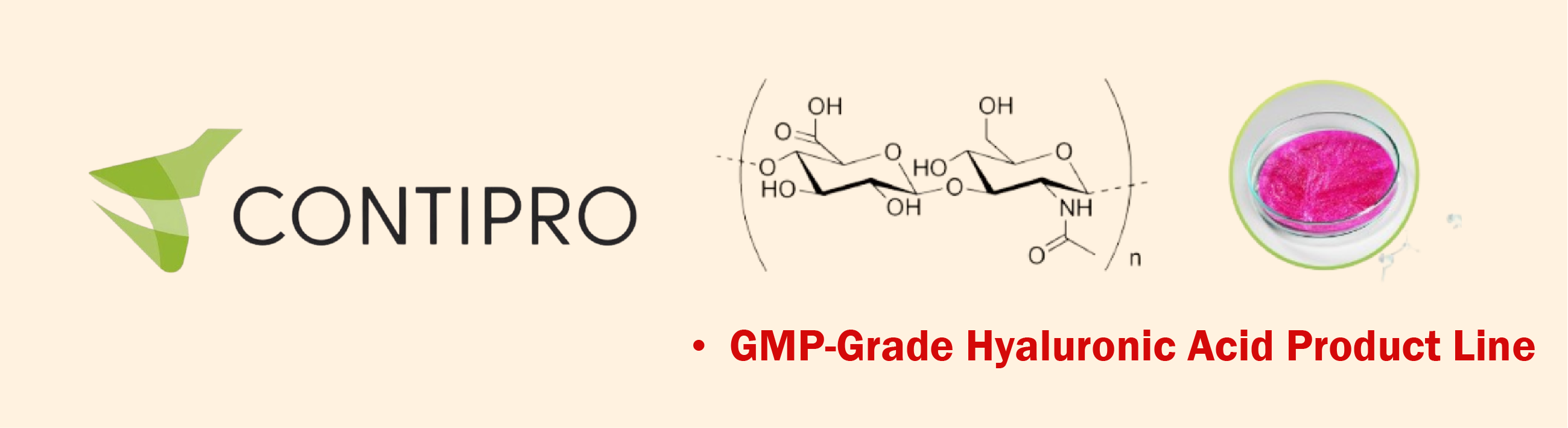
 Contipro is a leading European manufacturer of hyaluronic acid, headquartered in the Czech Republic, with hyaluronic acid as its flagship product. The company focuses on the research, development, and biotechnological production of high-quality hyaluronic acid and related applications. Its research is centered on the use of hyaluronic acid in tissue engineering, wound healing, nanotechnology, and drug delivery, while also covering finished formulations based on various polysaccharides. Contipro serves multiple sectors, including pharmaceuticals, cosmetics, medical devices, veterinary products, and advanced polymer applications. Official company information describes Contipro as a Czech-based manufacturer with hyaluronic acid as its flagship product and highlights its activities across active substances, pharmaceutical products, and innovative devices.
■ Product Portfolio
Vicbio Biotechnology Co., Ltd. provides the full range of Contipro products.
⇨ Inquire or Order immediately ⇦
●Pharmaceuticals
Contipro is committed to the research and development of hyaluronic acid materials and related applications that support future healthcare solutions. Its high-quality hyaluronic acid products can be used in a wide range of pharmaceutical formulations to improve product performance and therapeutic outcomes, with broad application potential in areas such as joint health and ophthalmology.
●Cosmetics
Contipro’s hyaluronic acid is widely used as a key ingredient in premium cosmetic products due to its high quality. Hyaluronic acid serves as a core active component and can be combined with designed peptides and other compounds. It helps provide deep hydration, improve skin elasticity, and reduce the appearance of wrinkles, supporting healthier and more youthful-looking skin.
●Medical Devices
☉Hyiodine®: A sterile medical device designed for covering, cleaning, and moisturizing deep wounds and skin defects. It helps create suitable healing conditions, and its lubricating properties help prevent dressings from adhering to the wound. It contains iodine and sodium hyaluronate. Official product information describes Hyiodine as a sterile wound-healing product for deep and hard-to-reach wounds.
☉Sorelex®: A sterile medical device designed for covering and healing chronic wounds. It contains octenidine dihydrochloride and sodium hyaluronate and consists of an active layer and an absorbent core. Its combined action helps create a favorable moist wound-healing environment. It is suitable for applications such as leg ulcers, diabetic foot ulcers, and dehisced surgical wounds. Contipro’s official product information describes Sorelex as a sterile medical device for chronic wounds containing octenidine dihydrochloride and sodium hyaluronate.
☉Sicalm HA: A sterile medical device in the form of a soft lyophilized tampon for adult patients after tooth extraction and dental procedures. It is used for the treatment of alveolitis and for wound care after dental surgery. On contact with saliva, it forms a gel that helps provide a suitable environment for healing, fills the wound, and offers mechanical protection. In addition to sodium hyaluronate, it also contains octenidine dihydrochloride to help reduce the risk of infection.
☉Fascigel HA: A sterile injectable medical device based on sodium hyaluronate, intended for intrafascial injection in the treatment of chronic myofascial back pain. It helps lubricate, hydrate, and physiologically regenerate the deep fascia, reducing friction and improving gliding function, mobility, and back stiffness. It is intended for use by appropriately trained healthcare professionals.
●Veterinary Products
☉Geloren Dog: Contains hyaluronic acid, chondroitin sulfate, glucosamine, hydrolyzed collagen, and gelatin. This combination supports the dog’s musculoskeletal system and is supplied in a liver-flavored jelly form. Official Contipro product information presents Geloren Dog as a complementary food containing these core ingredients.
☉Geloren HA: A nutritional supplement for horses intended for the care of joints, ligaments, and tendons, helping support a longer active life. Its main ingredients are hyaluronic acid and chondroitin sulfate. Official Contipro product information presents Geloren HA as a joint nutrition product for horses.
☉Bonharen®: A veterinary injectable product for joint-related applications. Official sources identify Bonharen as a veterinary injectable solution from Contipro for horses and dogs.
☉Anigran®: A veterinary wound-care product designed to support the healing of acute and chronic non-healing wounds in animals. It helps moisturize the wound, create suitable healing conditions, and prevent dressings from sticking. Official product information describes Anigran as a veterinary wound-healing gel.
●Polymers
Processable Polymers: Natural polymers such as hyaluronic acid, chitosan, and cellulose-based polysaccharides can be processed using 4SPIN technology. By combining electrospinning with airflow around the spinning head, hyaluronic acid can even be spun in its native form. For biomedical applications, natural polymers offer better biocompatibility and lower immunogenicity, opening new possibilities for scaffold development in regenerative medicine.
☉Synthetic Polymers: Most synthetic polymers commonly used in electrospinning can also be processed using 4SPIN technology. Their properties can be tailored for strength, morphology, flexibility, anisotropy, and other characteristics. Typical examples for biomedical use include PLA, PVA, PS, PGA, PEO, and PU.
☉Polymer Blends: In electrospinning, combining natural and synthetic polymers can deliver highly effective results. These blends provide a practical way to combine the strength and durability of synthetic polymers with the specific cell affinity of natural polymers.
■ Product List
| Product name | Range | Size | Cat. # |
| Sodium anhydroformyl hyaluronate | 50–200 kDa | 100 mg | 600-17-01 |
| Sodium anhydroformyl hyaluronate | 20–100 kDa | 100 mg | 600-17-02 |
| Sodium azidyl hyaluronate | 300–600 kDa | 1 g | 600-06-01 |
| Sodium butanoyl formyl hyaluronate | 20–200 kDa | 1 g | 600-26-01 |
| Sodium caproyl hyaluronate | 150–350 kDa | 1 g | 600-07-08 |
| Sodium caproyl formyl hyaluronate | 50–200 kDa | 1 g | 600-18-01 |
| Sodium formyl hyaluronate | 50–100 kDa | 1 g | 600-04-03 |
| Sodium formyl hyaluronate | 420–630 kDa | 1 g | 600-04-19 |
| Sodium formyl hyaluronate | 750–1050 kDa | 1 g | 600-04-20 |
| Sodium fluoresceinylamino hyaluronate | 30–200 kDa | 100 mg | 600-11-01 |
| Sodium linolenoyl hyaluronate | 10–20 kDa | 1 g | 600-20-01 |
| Sodium octanoyl formyl hyaluronate | 20–200 kDa | 1 g | 600-23-01 |
| Sodium oleyl hyaluronate | 5–20 kDa | 1 g | 600-19-01 |
| Sodium palmitoyl hyaluronate | 10–200 kDa | 1 g | 600-08-05 |
| Sodium palmitoyl hyaluronate | 300–350 kDa | 1 g | 600-08-02 |
| Sodium palmitoyl hyaluronate | 950–1150 kDa | 1 g | 600-08-15 |
| Sodium palmitoyl formyl hyaluronate | 20–200 kDa | 1 g | 600-24-01 |
| Sodium propinylamino hyaluronate | 300–600 kDa | 1 g | 600-05-01 |
| Hyaluronic acid methacrylate | 100-300 kDa | 1 g | 600-30-01 |
| Crosslinked Formyl HA | 240-400 kDa | 1 g | 600-31-01 |
| Sodium-calcium hyaluronate | 90–120 kDa | 1 g | 600-22-01 |
| Hyaluronan oligosaccharide | HA4AN | 10 mg | 600-03-01 |
| Hyaluronan oligosaccharide | HA6AN | 10 mg | 600-03-02 |
| Hyaluronan oligosaccharide | HA8AN | 10 mg | 600-03-03 |
| Hyaluronan oligosaccharide | HA10AN | 10 mg | 600-03-04 |
| Hyaluronan oligosaccharide | HA12AN | 10 mg | 600-03-05 |
| Hyaluronan oligosaccharide | HA14AN | 10 mg | 600-03-06 |
| Hyaluronan oligosaccharide | HA16AN | 10 mg | 600-03-07 |
| Hyaluronan oligosaccharide | HA18AN | 10 mg | 600-03-08 |
| Hyaluronan oligosaccharide | HA4AN | 10 mg | 600-03-10 |
| Hyaluronan oligosaccharide | HA6AN | 10 mg | 600-03-11 |
| Hyaluronan oligosaccharide | HA8AN | 10 mg | 600-03-12 |
| Hyaluronan oligosaccharide | HA10AN | 10 mg | 600-03-13 |
| Hyaluronan oligosaccharide | HA12AN | 10 mg | 600-03-14 |
| Hyaluronan oligosaccharide | HA14AN | 10 mg | 600-03-15 |
| Hyaluronan oligosaccharide | HA16AN | 10 mg | 600-03-16 |
| Hyaluronan oligosaccharide | HA18AN | 10 mg | 600-03-17 |
| Hyaluronan oligosaccharide | HA3AA | 10 mg | 600-16-06 |
| Hyaluronan oligosaccharide | HA5AA | 10 mg | 600-16-07 |
| Hyaluronan oligosaccharide | HA7AA | 10 mg | 600-16-08 |
| Hyaluronan oligosaccharide | HA9AA | 10 mg | 600-16-09 |
| Hyaluronan oligosaccharide | HA11AA | 10 mg | 600-16-10 |
| Hyaluronan oligosaccharide | HA3AA | 10 mg | 600-16-11 |
| Hyaluronan oligosaccharide | HA5AA | 10 mg | 600-16-12 |
| Hyaluronan oligosaccharide | HA7AA | 10 mg | 600-16-13 |
| Hyaluronan oligosaccharide | HA9AA | 10 mg | 600-16-14 |
| Hyaluronan oligosaccharide | HA11AA | 10 mg | 600-16-15 |
| Sodium hyaluronate with NMMD | 5–20 kDa | 100 mg | - |
| Sodium hyaluronate with NMMD | 20–30 kDa | 100 mg | - |
| Sodium hyaluronate with NMMD | 30–40 kDa | 100 mg | - |
| Sodium hyaluronate with NMMD | 40–60 kDa | 100 mg | - |
| Sodium hyaluronate with NMMD | 60–80 kDa | 100 mg | - |
| Sodium hyaluronate with NMMD | 80–100 kDa | 100 mg | - |
| Sodium hyaluronate with NMMD | 100–120kDa | 50 mg | - |
| Sodium hyaluronate with NMMD | 120–140kDa | 50 mg | - |
| Sodium hyaluronate with NMMD | 140–160kDa | 50 mg | - |
| Sodium hyaluronate with NMMD | 160–350Da | 50 mg | - |
| SET - Sodium hyaluronate with NMMD | 5–110 kDa | 220 mg | 600-21-10 |
| SET - Sodium hyaluronate with NMMD | 90–360 kDa | 65 mg | 600-21-11 |
| Sodium hyaluronate - laboratory | 8–15 kDa | 1 g; 5 g; 10 g | 600-01-01 |
| Sodium hyaluronate - laboratory | 15–30 kDa | 1 g; 5 g; 10 g | 600-01-02 |
| Sodium hyaluronate - laboratory | 30–50 kDa | 1 g; 5 g; 10 g | 600-01-03 |
| Sodium hyaluronate - laboratory | 50–90 kDa | 1 g; 5 g; 10 g | 600-01-04 |
| Sodium hyaluronate - laboratory | 90–130 kDa | 1 g; 5 g; 10 g | 600-01-05 |
| Sodium hyaluronate - laboratory | 130–300 kDa | 1 g; 5 g; 10 g | 600-01-06 |
| Sodium hyaluronate - laboratory | 300–500 kDa | 1 g; 5 g; 10 g | 600-01-07 |
| Sodium hyaluronate - laboratory | 500–750 kDa | 1 g; 5 g; 10 g | 600-01-08 |
| Sodium hyaluronate - laboratory | 750–1000 kDa | 1 g; 5 g; 10 g | 600-01-09 |
| Sodium hyaluronate - laboratory | 1000–1250 kDa | 1 g; 5 g; 10 g | 600-01-10 |
| Sodium hyaluronate - laboratory | 1250–1500 kDa | 1 g; 5 g; 10 g | 600-01-11 |
| Sodium hyaluronate - laboratory | 1500–1750 kDa | 1 g; 5 g; 10 g | 600-01-12 |
| Sodium hyaluronate - laboratory | 1750–2000 kDa | 1 g; 5 g; 10 g | 600-01-13 |
| Sodium hyaluronate - laboratory | 2000–2200 kDa | 1 g; 5 g; 10 g | 600-01-14 |
| Sodium hyaluronate - laboratory | 2200–2400 kDa | 1 g; 5 g; 10 g | 600-01-15 |
| Sodium hyaluronate - technical | 8–15 kDa | 1 g | 600-02-16 |
| Sodium hyaluronate - technical | 15–30 kDa | 1 g | 600-02-17 |
| Sodium hyaluronate - technical | 30–50 kDa | 1 g | 600-02-18 |
| Sodium hyaluronate - technical | 50–90 kDa | 1 g | 600-02-19 |
| Sodium hyaluronate - technical | 90–130 kDa | 1 g | 600-02-20 |
| Sodium hyaluronate - technical | 130–300 kDa | 1 g | 600-02-21 |
| Sodium hyaluronate - technical | 300–500 kDa | 1 g | 600-02-22 |
| Sodium hyaluronate - technical | 500–750 kDa | 1 g | 600-02-23 |
| Sodium hyaluronate - technical | 750–1000 kDa | 1 g | 600-02-24 |
| Sodium hyaluronate - technical | 1000–1250 kDa | 1 g | 600-02-25 |
| Sodium hyaluronate - technical | 1250–1500 kDa | 1 g | 600-02-26 |
| Sodium hyaluronate - technical | 1500–1750 kDa | 1 g | 600-02-27 |
| Sodium hyaluronate - technical | 1750–2000 kDa | 1 g | 600-02-28 |
| Sodium hyaluronate - technical | 2000–2200 kDa | 1 g | 600-02-29 |
| Sodium hyaluronate - technical | 2200–2400 kDa | 1 g | 600-02-30 |